FY 22/23_1st Report

ABOUT THIS REPORT

This sustainability report is the first report published by Myanma Awba Group. The report reflects our commitment to our stakeholders as we aim to act responsibly and transparently.

This report covers all of Myanma Awba Group’s business and entities. It includes the non-financial performance of our Group through quantitative data and qualitative information describing our actions, progress and results. All the quantitative data covers April 2022 to March 2023 (FY22/23) unless stated otherwise. The qualitative information covers the period from January 2022 to March 2023.

The data disclosed has not been audited by a third party.

Our non-financial reporting is aligned with the Global Reporting Initiative (GRI) Standards and will follow the GRI Sector Standard for Agriculture before 2024.

This report has been reviewed and validated by the Myanma Awba Group management on 24 February 2024.

Our website can be accessed for additional information related to our governance and sustainability.

ABOUT US

Established in 1995, Myanma Awba Group is a family-owned group of companies.¹ We are Myanmar’s largest manufacturer and distributor of agricultural technology, with a focus on crop protection, crop nutrition and high-quality seeds.

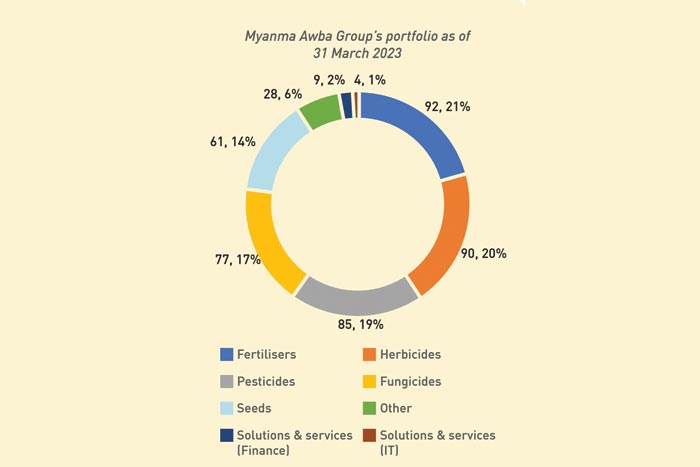
Our main activities are detailed below:

We recognise farmers’ needs to access to microloans and financial solutions to sustain and grow their small businesses. We aim to provide financial inclusion to all
Myanmar farmers.

We ensure that farmers can access our large portfolio of high-quality seeds of corn, vegetables, pulses and oilseeds enabling them to diversify their crops.

We leverage on technology to offer new services and solutions to help farmers optimise their yield, foster better returns on investments.

We manufacture a wide range of prducts including insecticides, fungicides, herbicides, foliar fertilisers, and plant growth regulators produced locally to ensure affordable prices.

We manage and market our 440 products. Our experts engage with our network of 3,360 distributors across the country and our agronomists advise farmers daily.

We produce high-quality, customised fertilisers with four core brands which deliver optimum nutrition for a wide range of crops, ensuring higher yields and improved profits for the farmers.

Strategic Report

Leadership statement

Dear readers,

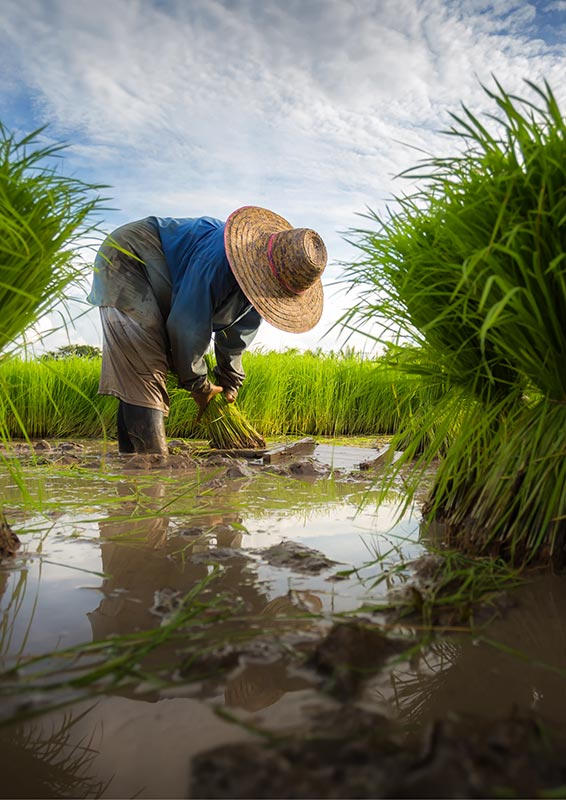
Agriculture is crucial for Myanmar. Farmers are the backbone of our economy: their work provides our country and people with food and jobs. Between January and December 2022, the agricultural sector accounted for 22% of Myanmar’s GDP and generated over 3 billion USD, ranking third after the gas and garment sectors. Every day, 7.1+ million Myanmar farmers work tirelessly to provide us with rice, vegetables and beans, which represent up to 75% of the calorie intake for Myanmar people and up to 50.8% of their daily expenditure.²

Better Agricultural practices

Enhancing farming practices is crucial not only in supporting farmers, but also in helping them deal with the consequences of climate change. At Myanma Awba Group, we are committed to reducing our carbon footprint and providing farmers with products and solutions that minimize environmental impacts, optimize yields, positively influence their livelihoods, and foster green farming.

Better Workplace

To serve our distributors and provide farmers with insights and expertise, we rely on our team of 2,600 staff members. For them, we are striving to ensure a safe and inclusive workplace. We are also investing in their training and taking steps to ensure that their compensation and benefits are fair and rewarding.

Being a good employer

At Myanma Awba Group, we are a multicultural company, and we benefit from the diverse backgrounds and expertise of our people. Our Code of Conduct frames our commitment to being an inclusive workplace, as we foster diversity and are doing our best to provide equal opportunities to women and men.

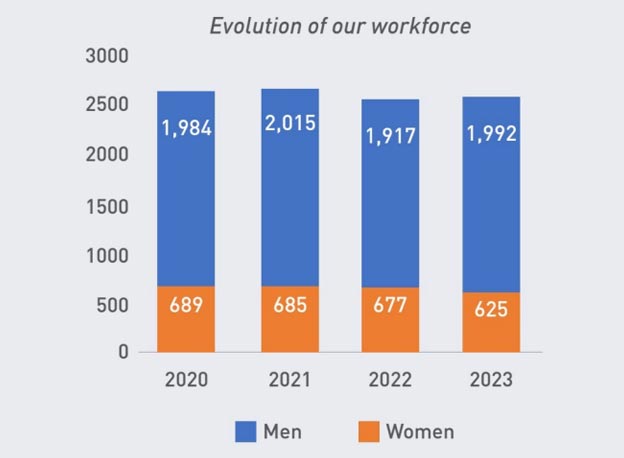
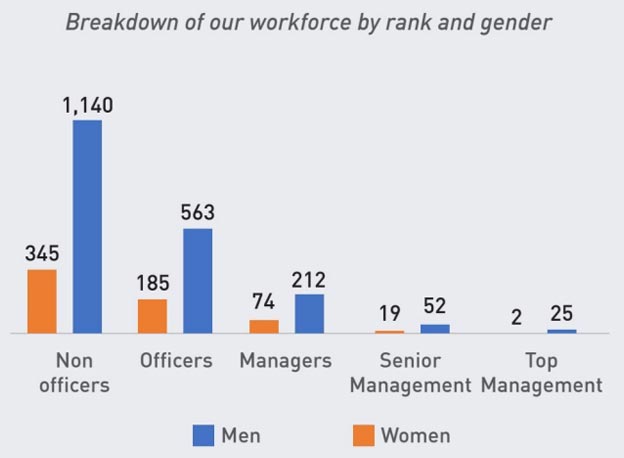
As a member of the Myanmar Business Coalition for Gender Equality, we are looking forward to enhancing our policies and results to make our workplace more inclusive. In 2023, we had 2,617 people working for us, of whom 24% were women. These numbers have been stable since 2020, as shown in the chart reflecting the evolution of our workforce since then. Our absenteeism rate remains very low (2% in 2023), and our turnover rate reached 18% last year. We hired 441 people, of whom 24% were women. We also promoted 91 people to higher positions, and 29% of promotions were granted to women. Among our managers, women hold 25% of the management positions in our Group.

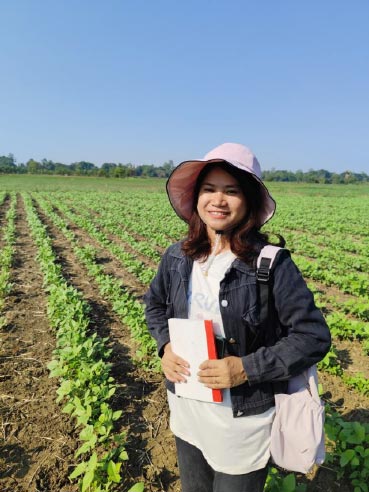
“When I joined Myanma Awba Group in 2017, I started to work in the R&D department where I was tasked with enhancing irrigation techniques. Afterwards, I joined Pahtama Seeds, and last year I was promoted. Today, I am responsible for engaging with a team of field supervisors who are in daily contact with farmers. We provide them with access to high-quality seeds, and are happy to share our expertise with them. Our work in the Magway region is meaningful, as we can see how farmers can benefit from our products and knowledge.”

Ma Kay Khine, Area Field Supervisor

Better Business Practices

As a company, we rely on natural and social ecosystems to prosper. We aim to minimize our environmental impacts to safeguard our environment and maximize our socioeconomic footprint to benefit Myanmar businesses and people, while conducting our business transparently and responsibly.

Reduce our environmental footprint

To manufacture our products, we rely on materials, energy and water. To ensure that our industrial activities do not harm the environment nor people, we have set clear policies and processes. We comply with the ISO 14001:2015 requirements for our environmental management of our industrial sites.

Furthermore, to minimize the environmental impacts of our industrial activities, especially on water, we have invested in building a state of the art wastewater treatment station. Furthermore, we carefully manage the storage of all the hazardous raw materials necessary to our production – we have documented more than 200+ substances that can be harmful, and have provided, in various material safety data sheets, instructions for handling any incidents. We also carefully monitor our air emissions to ensure that we comply with the guidelines provided by the Environmental Conservation Department (ECD) to avoid harming the air, water and soil.

Better All Together

Myanma Awba Group aims to engage with its stakeholders regularly: it is critical to build long-lasting relationships and safeguard our reputation and social license to operate. We are also keen to provide philanthropic support to initiatives aligned with our priorities.

Engaging proactively with our stakeholders

The trust and confidence of our stakeholders is one of the most critical assets for Myanma Awba Group. We engage regularly with our most important stakeholders and ensure that our approach is consistent and aligned with our policy.

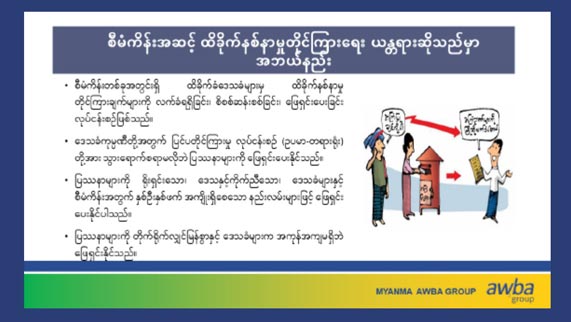
To ensure that people around our industrial sites are not impacted adversely by our operations, our Sustainability team regularly monitors grievances received from local communities. In 2023, we received 2 grievances, which were resolved promptly by implementing 3 corrective actions.

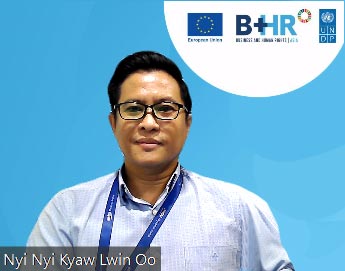
Our Chief Sustainability Officer shared our management approach during training organised by the Myanmar Sustainable Business Network in 2022.

During the session, we shared practical tools, as well as lessons learnt since we started to engage regularly and more efficiently with local communities.

Helping those in needs

At Myanma Awba Group, we aim to support and help those in need. Our CSR policy details our approach and the four pillars covering issues related to health, education, clean drinking water, disaster relief, etc.

Last year, we donated almost 300 million MMK to support various initiatives, compared to 45 million MMK in FY21/22 and 643 million MMK in FY20/21. As a Group, we decided to concentrate our efforts on supporting our people (see page 15) and distributors (see page 18).

ESG Reporting

Standards

We consider four main standards in shaping and structuring our non-financial reporting:

If you are passionate about agriculture and believe in its significance in changing lives, join us.

Explore a career with us